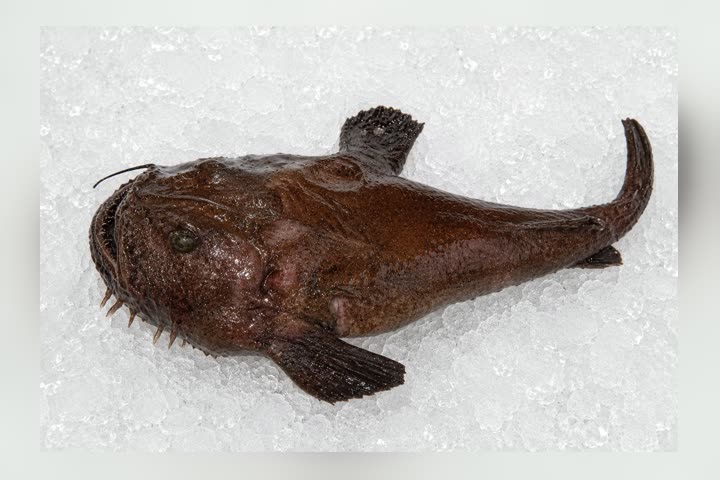
Wild
Ankou (Monkfish / Anglerfish) is one of Japan's great winter luxuries — a bizarre-looking deep-sea fish that becomes the star of the cold season. Everything about Ankou is unusual: its flesh is boneless (except for the spine), gelatinous when cooked, and its liver (ankimo) is considered the foie gras of the sea, ranking among Japan's three great chinmi (rare delicacies).
Traditional preparation is a spectacle — the 'tsurushi-giri' (hanging cut) technique suspends the whole fish from a hook and breaks it down entirely by knife, with 7 distinct edible parts. Every part of Ankou has value: the flesh, skin, stomach, ovaries, gills, fin, and above all, the liver.
Advance Intertrade sources Ankou from northern Japan (Ibaraki and Fukushima are the historical centers) and Nagasaki, with the winter months delivering the most magnificent specimens. Whole fish for restaurant tsurushi-giri, or pre-processed cuts for convenience.
The definitive winter dish — every part of the fish simmered in a rich miso or soy broth with vegetables. Body-warming, deeply satisfying.
The pinnacle of Ankou cuisine — the enormous liver is steamed, chilled, and sliced. Served with ponzu and grated daikon, it rivals fine foie gras.
The gelatinous flesh, dredged in flour and fried, becomes incredibly crispy outside and silky inside — a popular izakaya dish.
Ibaraki's regional specialty — a thick miso broth with all the Ankou parts, said to be a body-warming winter tonic.
| Size | Grade | Common Use |
|---|---|---|
| 3–5 kg | Small | Portion cuts, karaage, individual servings |
| 5–8 kg | Medium | Nabe, restaurant use — most popular |
| 8–12 kg | Large | Traditional tsurushi-giri, presentation |
| 12 kg+ | Jumbo | Show-stopper restaurant tsurushi-giri displays |
Tell us your target size, preferred form, quantity, and destination airport. We'll send you pricing and availability within 24 hours.
Contact Us